> For the complete documentation index, see [llms.txt](https://doc.thordata.com/doc/llms.txt). Markdown versions of documentation pages are available by appending `.md` to page URLs; this page is available as [Markdown](https://doc.thordata.com/doc/scraping/web-scraper-api/api-request-builder.md).

# API request builder

Learn how to use Thordata’s Web Scraper API to obtain your first scraped content.

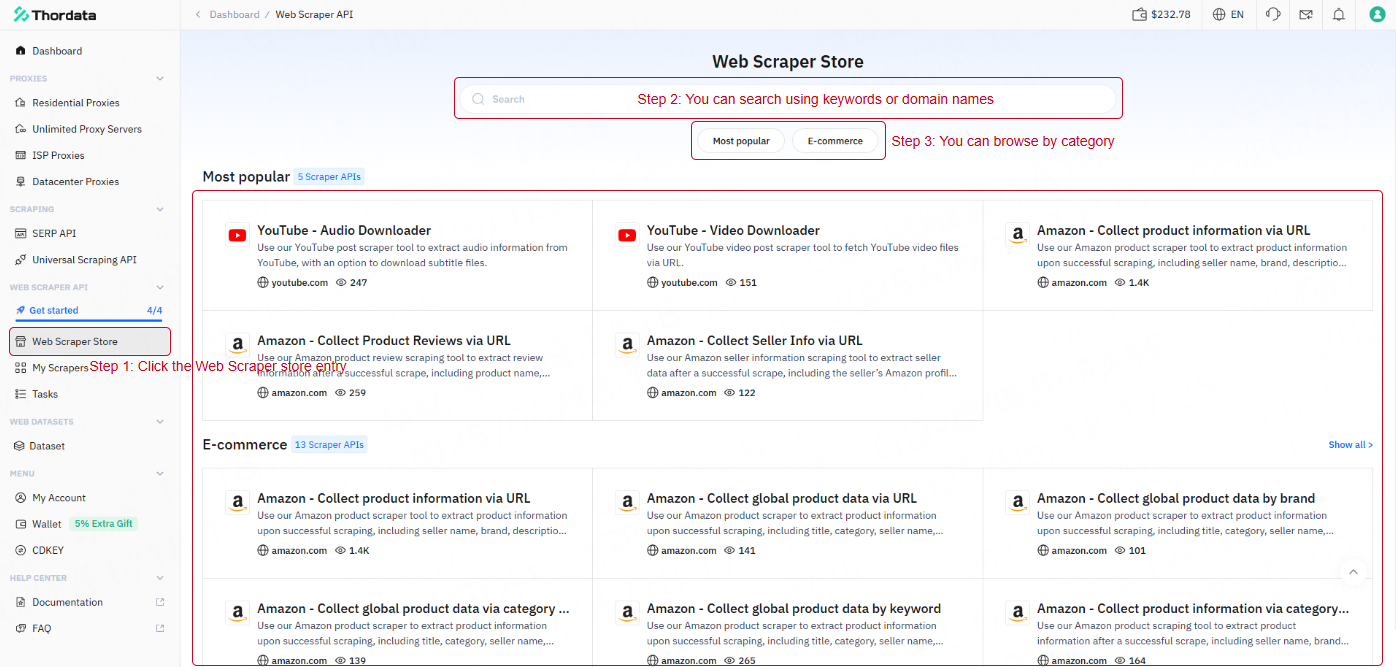
Navigate to the “[**API Request Builder**](https://dashboard.thordata.com/web-scraper)”

<div align="left"><figure><img src="/files/pMYb0CY4yGYbZIKpwd9G" alt="" width="563"><figcaption></figcaption></figure></div>

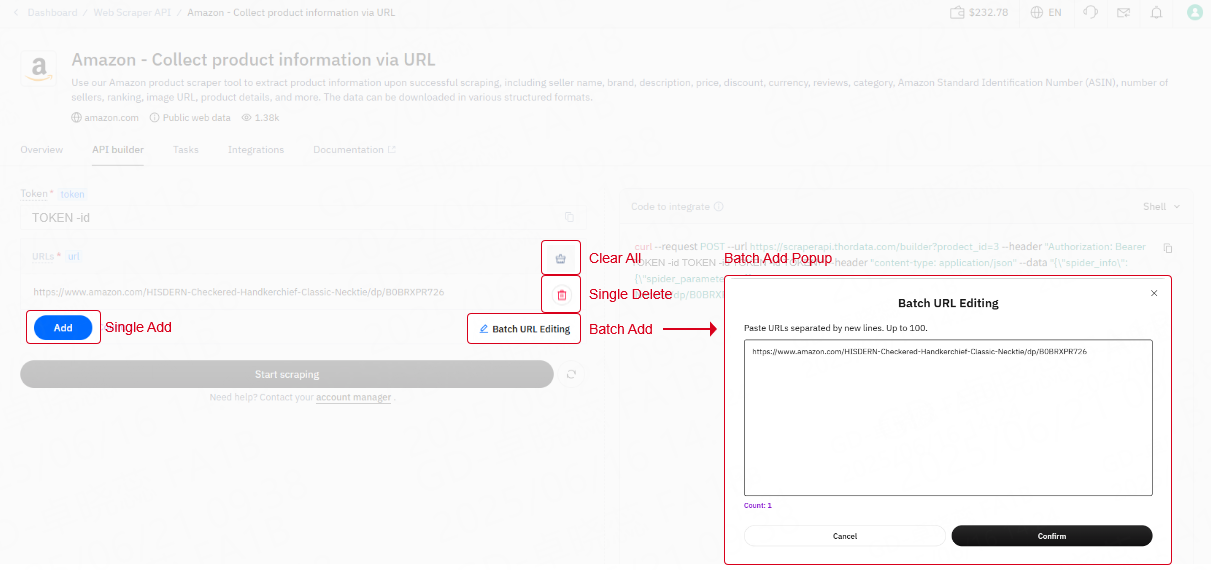
1. Enter URL   \
   You can add product detail URLs by clicking on \[Add Input]. Alternatively, you can directly copy multiple URLs into the input box in batches. Multiple URLs can be separated by line breaks or English commas.

<div align="left"><figure><img src="/files/lV2tH11RS9KBnf8w7HHx" alt="" width="563"><figcaption></figcaption></figure></div>

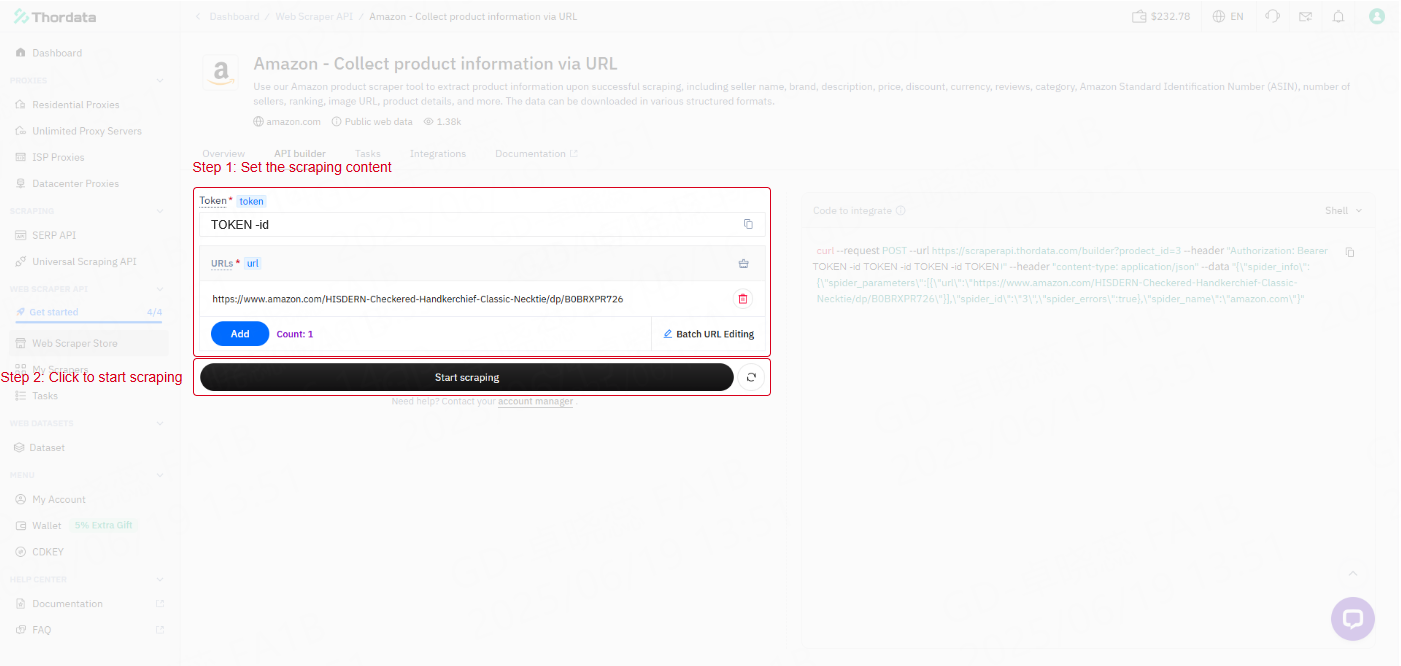
2. Start Scraping   \
   You can click on \[Start Scraping], or execute the verified request code to run the scraping. You can also run it directly using the code examples on the right side.

<div align="left"><figure><img src="/files/fLzazNDBhlXkTR3HHWGx" alt="" width="563"><figcaption></figcaption></figure></div>

3. Check Results   \
   You can view all your running crawling plans in "Tasks", and you can also download the crawling results in JSON or CSV format from the logs.

<div align="left"><figure><img src="/files/TrkQgpACC7p2c1sPAC3E" alt="" width="563"><figcaption></figcaption></figure></div>

If you need further assistance, please contact us via email at <support@thordata.com>.


---

# Agent Instructions
This documentation is published with GitBook. GitBook is the documentation platform designed so that both humans and AI agents can read, navigate, and reason over technical content effectively. Learn more at gitbook.com.

## Querying This Documentation
If you need additional information that is not directly available in this page, you can query the documentation dynamically by asking a question.

Perform an HTTP GET request on the current page URL with the `ask` query parameter:

```
GET https://doc.thordata.com/doc/scraping/web-scraper-api/api-request-builder.md?ask=<question>
```

The question should be specific, self-contained, and written in natural language.
The response will contain a direct answer to the question and relevant excerpts and sources from the documentation.

Use this mechanism when the answer is not explicitly present in the current page, you need clarification or additional context, or you want to retrieve related documentation sections.